Facebook is the most popular social networking site in several English-speaking countries, including Canada,[292] the United Kingdom,[293] and the United States.[294][295][296] However, Facebook still receives limited adoption in countries such as Japan, where domestically created social networks are still largely preferred.[297] In regional Internet markets, penetration on Facebook is highest in North America (69 percent), followed by Middle East-Africa (67 percent), Latin America (58 percent), Europe (57 percent), and Asia-Pacific (17 percent).[298] Some of the top competitors were listed in 2007 by Mashable.[299]
The website has won awards such as placement into the "Top 100 Classic Websites" by PC Magazine in 2007,[300] and winning the "People's Voice Award" from the Webby Awards in 2008.[301] In a 2006 study conducted by Student Monitor, a company specializing in research concerning the college student market, Facebook was named the "second most popular thing among undergraduates," tied with beer and only ranked lower than the iPod.[302]
In 2010, Facebook won the Crunchie "Best Overall Startup Or Product" for the third year in a row[303] and was recognized as one of the "Hottest Silicon Valley Companies" by Lead411.[304] However, in a July 2010 survey performed by the American Customer Satisfaction Index, Facebook received a score of 64 out of 100, placing it in the bottom 5% of all private-sector companies in terms of customer satisfaction, alongside industries such as the IRS e-file system, airlines, and cable companies. The reasons why Facebook scored so poorly include privacy problems, frequent changes to the website's interface, the results returned by the News Feed, and spam.[305]
| Date | Users (in millions) |
Days later | Monthly growth[N 2] |
|---|---|---|---|
| February 4, 2004 | 0 | — | — |
| August 26, 2008 | 100[306] | 1,665 | 178.38% |
| April 8, 2009 | 200[307] | 225 | 13.33% |
| September 15, 2009 | 300[308] | 160 | 9.38% |
| February 5, 2010 | 400[309] | 143 | 6.99% |
| July 21, 2010 | 500[310] | 166 | 4.52% |
| January 5, 2011 | 600[311][N 3] | 168 | 3.57% |
| May 30, 2011 | 700[312] | 145 | 3.45% |
| September 22, 2011 | 800[313] | 115 | 3.73% |
| April 24, 2012 | 900[314] | 215 | 1.74% |
| September 14, 2012 | 1,000[315] | 143 | 2.33% |
| March 31, 2013 | 1,110[316] | 198 | 1.5% |
| December 31, 2013 | 1,230[317] | 275 | 0.97% |
| December 31, 2014 | 1,390[318] | 365 | 0.64% |
By 2005, the use of Facebook had already become so ubiquitous that the generic verb "facebooking" had come into use to describe the process of browsing others' profiles or updating one's own.[323] In 2008, Collins English Dictionary declared "Facebook" as its new Word of the Year.[324] In December 2009, the New Oxford American Dictionary declared its word of the year to be the verb "unfriend", defined as "To remove someone as a 'friend' on a social networking site such as Facebook.[325]
In early 2010, Openbook was established, an avowed parody (and privacy advocacy) website[326] that enables text-based searches of those Wall posts that are available to "Everyone", i.e. to everyone on the Internet.
Writers for The Wall Street Journal found in 2010 that Facebook apps were transmitting identifying information to "dozens of advertising and Internet tracking companies". The apps used an HTTP referer which exposed the user's identity and sometimes their friends'. Facebook said, "We have taken immediate action to disable all applications that violate our terms".[327]
In May 2014, the countries with the most Facebook users were:[328]
- United States with 151.8 million members
- India with 108.9 million members
- Brazil with 70.5 million members
- Indonesia with 60.3 million members
- Mexico with 44.4 million members
All of the above total 309 million members or about 38.6 percent of Facebook's 1 billion worldwide members.[329] As of March 2013, Facebook reported having 1.11 billion monthly active users, globally.[330]

Facebook Android Logos
-
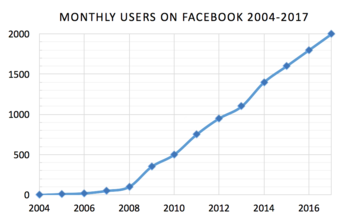 Facebook popularity. Active users of Facebook increased from just a million in 2004 to over 750 million in 2011.[333]
-


Criticisms and controversies
Main article: Criticism of Facebook
Electricity usage
On April 21, 2011, Greenpeace released a report showing that of the top ten big brands in cloud computing, Facebook was most reliant on coal for electricity for its data centers. At the time, data centers consumed up to 2% of all global electricity and this amount was projected to increase. Phil Radford of Greenpeace said "we are concerned that this new explosion in electricity use could lock us into old, polluting energy sources instead of the clean energy available today."[335] On December 15, 2011, Greenpeace and Facebook announced together that Facebook would shift to use clean and renewable energy to power its own operations. Marcy Scott Lynn, of Facebook's sustainability program, said it looked forward "to a day when our primary energy sources are clean and renewable" and that the company is "working with Greenpeace and others to help bring that day closer."[336][337]NSA Prism program
Following media reports about PRISM, NSA's massive electronic surveillance program, in June 2013, several technology companies were identified as participants, including Facebook. According to leaks of said program, Facebook joined the PRISM program in 2009.[339]Users violating minimum age requirements
A 2011 study in the online journal First Monday, examines how parents consistently enable children as young as 10 years old to sign up for accounts, directly violating Facebook's policy banning young visitors. This policy is in compliance with a United States law, the 1998 Children's Online Privacy Protection Act, which requires minors aged 13 or younger to gain explicit parental consent to access commercial websites. In other jurisdictions where a similar law sets a lower minimum age, Facebook enforces the lower age. Of the 1,007 households surveyed for the study, 76% of parents reported that their child joined Facebook at an age younger than 13, the minimum age in the site's terms of service. The study also reported that Facebook removes roughly 20,000 users each day for violating its minimum age policy. The study's authors also note, "Indeed, Facebook takes various measures both to restrict access to children and delete their accounts if they join." The findings of the study raise questions primarily about the shortcomings of United States federal law, but also implicitly continue to raise questions about whether or not Facebook does enough to publicize its terms of service with respect to minors. Only 53% of parents said they were aware that Facebook has a minimum signup age; 35% of these parents believe that the minimum age is merely a recommendation, or thought the signup age was 16 or 18, and not 13.[340]Accounts hacked in Bangalore, India
In November 2011, several Facebook users in Bangalore, India reported that their accounts had been hacked and their profile pictures replaced with pornographic images. For more than a week, users' news feeds were spammed with pornographic, violent and sexual content, and it was reported that more than 200,000 accounts were affected. Facebook described the reports as inaccurate, and Bangalore police speculated that the stories may have been rumors spread by Facebook's competitors.[341][342]Unauthorized wall posting bug
On August 19, 2013, it was reported that a Facebook user from Yatta, West Bank[343][344] Khalil Shreateh had found a bug that allowed him to post material to other users' Facebook Walls. Users are not supposed to have the ability to post material to the Facebook Walls of other users unless they are approved friends of those users that they have posted material to. To prove that he was telling the truth, Shreateh posted material to Sarah Goodin's wall, a friend of Facebook CEO Mark Zuckerberg. Following this, Shreateh contacted Facebook's security team with the proof that his bug was real, explaining in detail what was going on. Facebook has a bounty program in which it compensates people a US$500 fee for reporting bugs instead of using them to their advantage or selling them on the black market. However, it was reported that instead of fixing the bug and paying Shreateh the fee, Facebook originally told him that "this was not a bug" and dismissed him. Shreateh then tried a second time to inform Facebook, but they dismissed him yet again. On the third try, Shreateh used the bug to post a message to Mark Zuckerberg's Wall, stating "Sorry for breaking your privacy … but a couple of days ago, I found a serious Facebook exploit" and that Facebook's security team was not taking him seriously. Within minutes, a security engineer contacted Shreateh, questioned him on how he performed the move and ultimately acknowledged that it was a bug in the system. Facebook temporarily suspended Shreateh's account and fixed the bug after several days. Facebook refused to pay out the bounty to Shreateh, stating that by posting to Zuckerberg's account, Shreateh had violated one of their terms of service policies and therefore "could not be paid." Facebook also noted that in Shreateh's initial reports, he had failed to provide technical details for Facebook to act on the bug.[345][346][347]On August 22, 2013, Yahoo News reported that Marc Maiffret, a chief technology officer of the cybersecurity firm BeyondTrust, is prompting hackers to support in raising a $10,000 reward for Khalil Shreateh. On August 20, Maiffret stated that he had already raised $9,000 in his efforts, including the $2,000 he himself contributed. He and other hackers alike have denounced Facebook for refusing Shreateh compensation. Stated Maiffret, "He is sitting there in Palestine doing this research on a five-year-old laptop that looks like it is half broken. It's something that might help him out in a big way." Facebook representatives have since responded, "We will not change our practice of refusing to pay rewards to researchers who have tested vulnerabilities against real users." Facebook representatives also claimed they'd paid out over $1 million to individuals who have discovered bugs in the past.[348]

No comments:
Post a Comment